Left-handed kids at school: the supplies that actually work for them
My best friend growing up was left-handed. She always measured and drew lines from right to left, because that was what felt natural to her. It was only years later, working in the stationery industry, that I realized there are rulers made exactly for that. Small things like this make a bigger difference than most parents expect.
Around ten to thirteen percent of people are left-handed, which means there is a good chance your child is too. Most school supplies are designed for right-handed use without anyone ever mentioning it on the packaging. This guide covers the supplies where it genuinely matters, and what to look for.
For a full overview of what to buy for school, my complete school supplies guide covers everything from notebooks to backpacks.
Why left-handed kids need different supplies
Left-handed kids do not need a completely different set of everything. Most school supplies work fine for both hands. But there are a few categories where the design of a standard product actively works against left-handed kids, making tasks harder or more frustrating than they need to be. In those categories, a left-handed version is not a luxury. It is just the right tool.
The earlier left-handed kids get the right supplies, the fewer workarounds they develop. Many left-handed adults have spent years compensating for tools that were not designed for them, without ever realizing there was a better option. A small investment at the start of school can prevent a lot of unnecessary frustration.
Scissors: the most important left-handed purchase
Scissors are where the difference matters most. Standard scissors are designed for right-handed use, which means the blade is positioned so that a right-handed person can see the cutting line clearly as they cut. When left-handed kids use standard scissors, the blade covers the cutting line. They have to twist their wrist awkwardly to see where they are cutting, which makes clean, accurate cuts nearly impossible.
In practice, most left-handed kids using right-handed scissors end up tearing the paper rather than cutting it, cutting at an angle without realizing why, and tiring out quickly from the awkward grip. If your child comes home frustrated with cutting activities, the scissors are almost certainly the reason.
Left-handed scissors have the blades reversed, so that left-handed kids have the same clear view of the cutting line that a right-handed child gets automatically. The difference in cutting accuracy and comfort is immediate.
For younger children who are just learning to use scissors, look for a pair with a visual guide on the handle that shows which hand to use. Some scissors have a small indicator, like a smiley face, positioned so that it faces the child when the scissors are held correctly. This takes the guesswork out of picking up the scissors and helps build the right habit from the start.
Left-handed scissors are widely available and cost the same as standard children’s scissors. If your child is clearly left-handed, left-handed scissors are usually one of the best investments you can make.
Rulers: measuring in the right direction
A standard ruler starts with zero on the left and increases toward the right. For a right-handed person drawing a line from left to right, this is intuitive. For left-handed kids drawing from right to left, the numbers run in the wrong direction. They have to mentally reverse the scale every time they measure, which adds an extra mental step that some children find frustrating.
Many left-handed rulers are designed with a reverse or dual scale, making measurements easier to read from right to left. This means left-handed kids can measure and draw lines in the direction that feels natural without having to mentally reverse the scale.
Pencils and crayons: mostly fine, with one exception
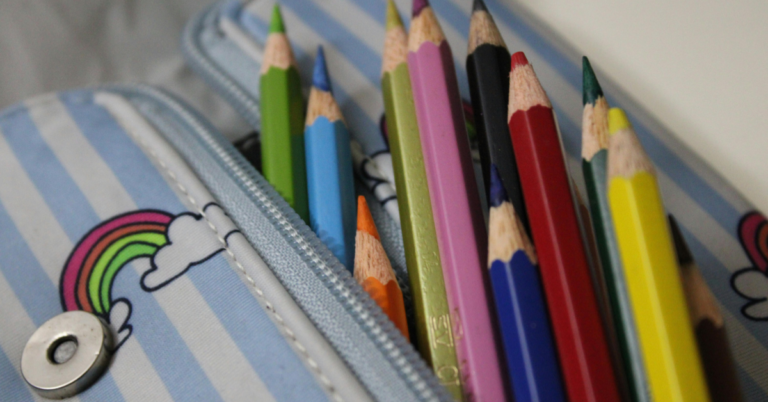
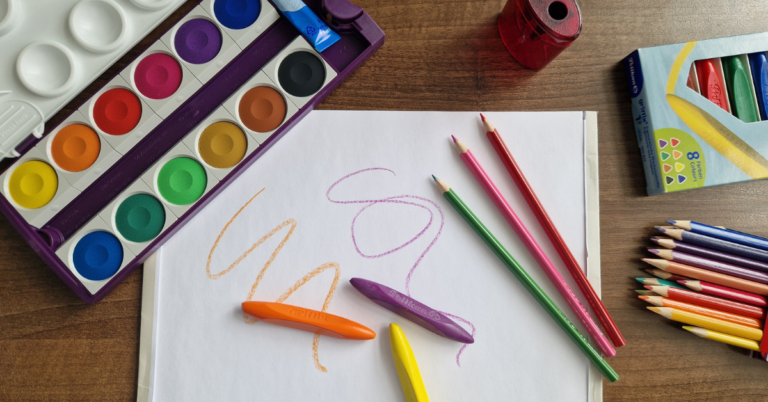
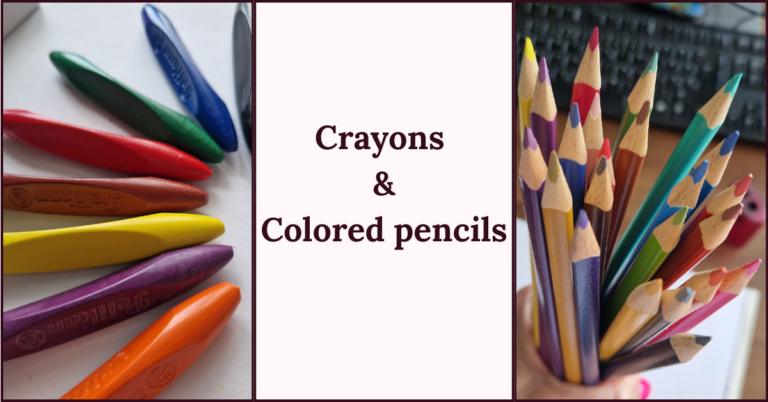
The good news for left-handed kids is that most pencils and crayons work perfectly well for both hands. Palm-grip crayons, triangular jumbo crayons, and triangular colored pencils are all equally suitable for left-handed kids, both in jumbo and standard width. The ergonomic shapes that help right-handed children develop a natural grip do the same for left-handed kids.
The one thing worth paying attention to is break resistance. A break-resistant pencil with a well-bonded lead is worth choosing for any child, and left-handed kids are no exception.
For more detail on choosing the right pencils and crayons at each stage of development, my crayons and colored pencils guide covers the full progression.
Notebooks and spiral notebooks: a simple fix
Standard spiral notebooks have the binding on the left side. For a right-handed writer, the spiral sits away from the writing hand. For a left-handed writer, the spiral sits directly under the writing hand, pressing against the wrist throughout the entire writing session. This is uncomfortable and tiring, especially during longer writing tasks.
Purpose-made left-handed spiral notebooks exist, with the binding on the right side. But there is a free solution that works just as well: a standard spiral notebook used from back to front. When left-handed kids open the notebooks from the back and write toward the front, the spiral ends up on the right side, exactly where it should be. If your child’s school requires composition notebooks, this trick obviously won’t apply, since they are bound differently.
Many left-handed kids also prefer stapled composition notebooks or top-bound notebooks, where there is no spiral at all. These avoid the wrist problem entirely and are worth considering as a simple alternative.
It is worth mentioning this to your child’s teacher so the format is understood and accepted in class.
Desk setup: a small change that helps
This is not a product recommendation but a practical tip. Many left-handed children naturally prefer keeping frequently used supplies on their right side so they can reach for them without crossing over their writing hand. Others prefer the opposite. Let your child decide what feels most comfortable.
Classroom seating: worth a conversation with the teacher
In many elementary school classrooms, students sit in pairs at shared desks or at two desks pushed together. If your left-handed child sits next to a right-handed classmate, their writing elbows will compete for the same space all day. It is an easy problem to prevent and an exhausting one to ignore.
If your child’s classroom uses paired seating, it is worth asking the teacher at the start of the school year whether your child can sit on the left side of the pair. This puts their writing elbow on the outside, away from their neighbor, and makes the whole day more comfortable for both children. Most teachers are happy to accommodate this once they understand the reason.
Pens: the smearing problem and how to reduce it
Many left-handed writers find that their hand passes over freshly written ink, which can cause smudging. This is particularly noticeable with slower-drying inks.
For school-age children who are starting to write with pens rather than pencils, choosing a ballpoint pen or a quick-drying gel pen reduces the problem significantly. Ballpoint ink dries almost instantly, making it the most practical everyday choice for left-handed writers. Quick-drying gel pens are also widely available and work well.
Most left-handed writers naturally develop their own way of angling their hand or the paper over time to avoid smearing. It tends to sort itself out with practice, but starting with the right pen makes the process less frustrating.
When do you know your child is left-handed?
Most children show a clear hand preference between the ages of two and four, though some children take longer to settle. If your child consistently reaches for objects with the same hand, holds crayons and pencils with the same hand, and feels uncomfortable when asked to switch, that is a reliable sign of hand preference.
It is worth knowing before the first day of school so that you can buy the right scissors and ruler in advance. Left-handed supplies are not always available in every school supply store, so ordering online before the school year starts is a good idea.
A quick checklist for left-handed school supplies
Left-handed scissors, sized for children, with a visual guide if possible for younger children. A left-handed ruler with measurements readable from both directions, or a standard ruler used upside down. Triangular pencils and crayons, which work well for both hands. A spiral notebook with binding on the right, or a standard notebook used from back to front. Pencil case positioned wherever your child can reach tools most comfortably.
That is the full list. It is shorter than most parents expect, and most of it costs no more than standard supplies.
Frequently asked questions
Do left-handed kids need special pencils?
Not usually. Most pencils work well for both hands. Triangular pencils are a good choice for left-handed children because the shape supports a natural grip regardless of which hand is used. Break-resistant pencils are worth choosing for any child, and left-handed kids are no exception.
What is the difference between left-handed and right-handed scissors?
The blades are reversed. In standard scissors, the blade position allows a right-handed person to see the cutting line clearly. In left-handed scissors, the blades are reversed so that a left-handed person has the same clear view. Using the wrong scissors makes accurate cutting much harder and forces an awkward wrist position.
Can left-handed children use standard scissors?
They can, but it is harder. Standard scissors require a left-handed child to twist their wrist to see the cutting line, which makes clean cuts difficult and can be uncomfortable during longer craft sessions. Left-handed scissors cost the same as standard ones and make an immediate difference.
What is a left-handed ruler?
Many left-handed rulers use a reverse or dual scale, making measurements easier to read from right to left.
How do I know if my child is left-handed?
Most children show a consistent hand preference between ages two and four. If your child reliably reaches for objects, holds crayons, and performs tasks with the same hand, that is a reliable sign. Some children take longer to settle on a dominant hand, and that is normal too.
Are left-handed school supplies expensive?
No. Left-handed scissors and rulers are widely available and priced the same as standard versions. The notebook solution costs nothing at all. The total investment in left-handed supplies is very small compared to the difference it makes.
Do left-handed children need special crayons?
No. Palm-grip crayons, triangular jumbo crayons, and standard crayons all work equally well for left-handed kids. The ergonomic shapes designed to help young children develop a natural grip do so regardless of which hand is dominant.
Should I tell the teacher my child is left-handed?
Yes, it is worth mentioning at the start of the school year. Many teachers are happy to accommodate simple adjustments once they are aware of them. It also helps if your child uses a notebook from back to front, so the teacher understands the format
At what age should I buy left-handed scissors for my child?
As soon as your child starts using scissors, which for most children is around age three to four. There is no reason to wait. Left-handed scissors are available in preschool sizes and make the experience of learning to cut much easier from the start.
Is it worth buying all left-handed versions of school supplies?
No. Most school supplies work perfectly well for both hands. The ones where a left-handed version genuinely matters are scissors and rulers. Everything else, pencils, crayons, erasers, glue, and pencil cases, is the same for both hands.