Pencil box vs pencil pouch: read this before you buy a pencil case
Sooner or later, every parent working through a school supply list hits the same question: pencil box or pencil pouch? The two words look interchangeable, but they are not, and choosing the wrong one is one of the most common reasons a brand new pencil case ends up replaced by October.
The short answer: buy exactly what the teacher’s supply list says. If the list does not specify, younger students, kindergarten through 2nd grade, usually manage a hard plastic pencil box more easily, while a zippered pencil pouch tends to suit 3rd grade and up. Everything below explains why, and what to look for once you know which type you need.
I spent 25 years working in the stationery industry before I became a mom, and pencil cases were part of my daily work for most of that time. I have seen which ones come back as complaints and which ones survive a full school year. This guide is everything I would tell a friend standing in the back to school aisle.
First, check the teacher’s supply list
Before you fall in love with any pencil case, find the supply list. Not the generic one from a store display. The actual list from your child’s school or teacher.
This matters more with pencil cases than with almost any other school supply, because teachers have strong and practical reasons for asking for one type over the other. A teacher who asks for a pencil box has usually planned her classroom storage around stackable boxes in cubbies or desks. A teacher who asks for a zippered pouch often has no desk storage at all, and everything travels in the backpack. Some lists even say “no hard plastic, please,” and that request is not a matter of taste. Hard boxes crack when they hit the floor, and in some classrooms they simply do not fit the space.
When a first grade teacher’s supply advice went viral a while back, her number one tip for parents was simple: follow the district’s list as closely as possible, because teachers themselves put those lists together. You can read the full story on Good Morning America.
If you cannot find your school’s list, TeacherLists.com is a free tool where you can search for your child’s actual supply list by school or zip code. And if you are building your full shopping list from scratch, my honest guide to the elementary school supplies list walks through every item on a typical list, not just the pencil case.
If the list names a specific type, your decision is made. Buy that type. The rest of this article helps you choose a good one within the type, and helps you decide for yourself when the list stays silent.
If the list says pencil box
A pencil box is the rigid plastic case, usually about 8 x 5 inches, with a snap or latch lid. In American classrooms this is the most common choice for the youngest students, though not a universal one, since some schools ask for a pouch as early as kindergarten. Where the box is the standard, there are good reasons for it.
Small hands manage a box more easily than a zipper. The box opens flat, so a five year old sees everything at once instead of digging blind into a pouch. Boxes stack neatly, which is one reason many teachers prefer them in the early grades: twenty-four boxes fit into a cubby shelf, twenty-four soft pouches turn into a pile. And a box protects its contents. Crayons do not snap and pencil points survive the trip when the case itself does not bend.
What to look for when you buy one:
The latch. This is the single most important feature, and the one parents test least. Your child needs to open and close it alone, quickly, without help and ideally with one hand holding the box. A latch that is too stiff turns into a daily frustration, and a latch that is too loose spills forty crayons across the classroom floor. If you are shopping in a store, let your child open and close the box a few times before you decide.
The size. Standard school boxes run close to 8 x 5 inches for a reason: they fit inside desks and standard cubbies. An oversized box might hold more, but if it does not fit the desk, it becomes the teacher’s problem, and then yours.
The surface. A box with a plain, smooth surface takes a name label well and holds it all year. Heavily textured or fully printed boxes make labels peel, and an unlabeled box in a classroom of twenty-four identical boxes goes missing fast.
One nuance worth knowing: some teachers prefer clear or translucent boxes because they can see at a glance whether supplies are inside. It is rarely a requirement, but if the list mentions “clear pencil box,” that is the reason, and a solid-colored box is not a safe substitute.
If the list says pencil pouch
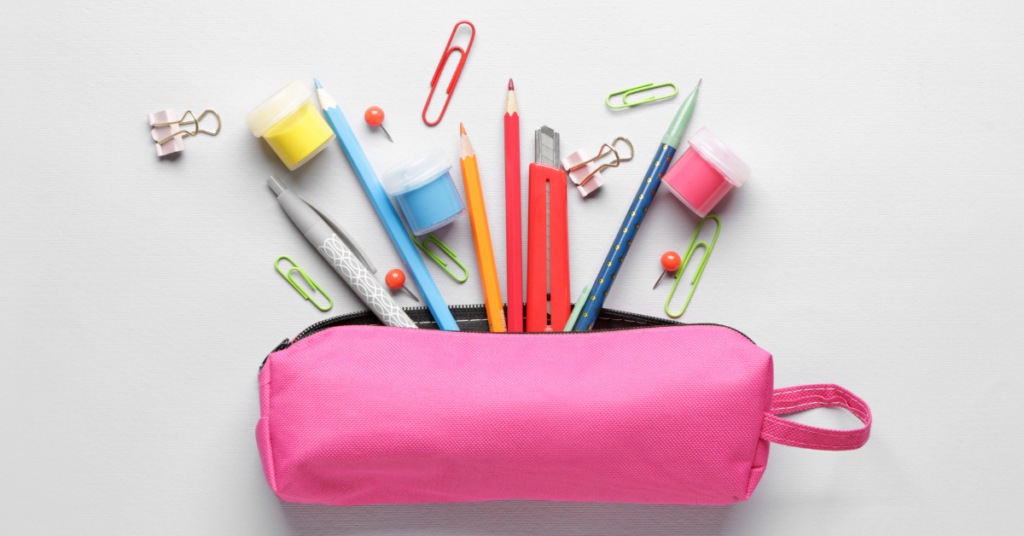
A pencil pouch is the soft, zippered case, usually fabric or flexible plastic. From around 3rd grade, this becomes the more common request, and by middle school it is nearly universal.
The logic follows how classroom life changes. Older students carry their supplies between rooms instead of storing them in one desk. A pouch squeezes into a full backpack, weighs almost nothing, and does not crack when the backpack lands on the floor, which it will, roughly four hundred times a year. A pouch is also quiet. Anyone who has heard twenty-four plastic latches open at once understands why some teachers make the switch as early as they reasonably can.
What to look for:
The zipper, always the zipper. In my stationery years, a broken zipper was the most common pencil case complaint we ever received, ahead of everything else combined. Test it in the store: run it back and forth several times, feel for catching, and check that the pull is big enough for a child’s fingers. Metal zippers generally outlast plastic coil zippers. A pouch is only as good as its zipper, because when the zipper fails, the pouch is trash, no matter how nice the fabric is.
The shape. Flat pouches slide into binders and slim backpack pockets, and this is the style most supply lists quietly assume. Rounded shapes, the barrel, oval, and triangle cases, hold a surprising amount, but the child looks into them through a narrow opening, so more digging comes with the extra room. Pouches with a wide, flat bottom stand open on a desk and show their contents best, at the cost of more space in the backpack. Match the shape to where the pouch will spend its day: mostly in a desk or on a desktop, the wide bottom earns its space; mostly traveling in a backpack or binder, flat wins.
A window helps. Some pouches have a mesh or clear vinyl panel. It sounds like a gimmick, but it solves the biggest weakness of a pouch: the child cannot see what is inside. A window means less digging and fewer “I lost my eraser” moments when the eraser was there all along.
The fabric. Canvas and polyester survive washing. And a pencil pouch will need washing, probably sooner than you expect.
If the list says 3-ring binder pouch
This one confuses parents who did not grow up with American binders, so here is the short version: a binder pouch is a zippered pouch with a reinforced edge and three metal-rimmed holes, made to clip into a 3-ring binder and travel inside it.
Schools that run on binders, mostly upper elementary and middle school, ask for this type so that pens and pencils live where the paper lives. The student opens the binder and everything is there. Nothing separate to forget, nothing loose at the bottom of the backpack.
Two things decide whether a binder pouch survives the year. First, the holes: look for metal grommets or thick reinforced plastic around them, because plain punched holes in fabric tear out within weeks. Second, the profile: a flat or lightly filled pouch rides well in a binder, while an overstuffed one strains the rings and eventually bends them. A binder pouch is a home for the essentials, five or six items, not for the full pencil collection.
If the list asks for this type, resist the urge to buy a regular pouch instead and figure it out later. A pouch without binder holes cannot do the one job this item exists for.
What about European-style organizer pencil cases?
Here is where I let my background show. I grew up in Hungary and spent my career in the European stationery industry, and the pencil case of my childhood was a different creature entirely: a case that unfolds like a book, with elastic loops inside, one loop for every pencil, pen, and marker. Every tool has its own place. The child opens the case and sees the whole kit at a glance, like a tiny toolbox.
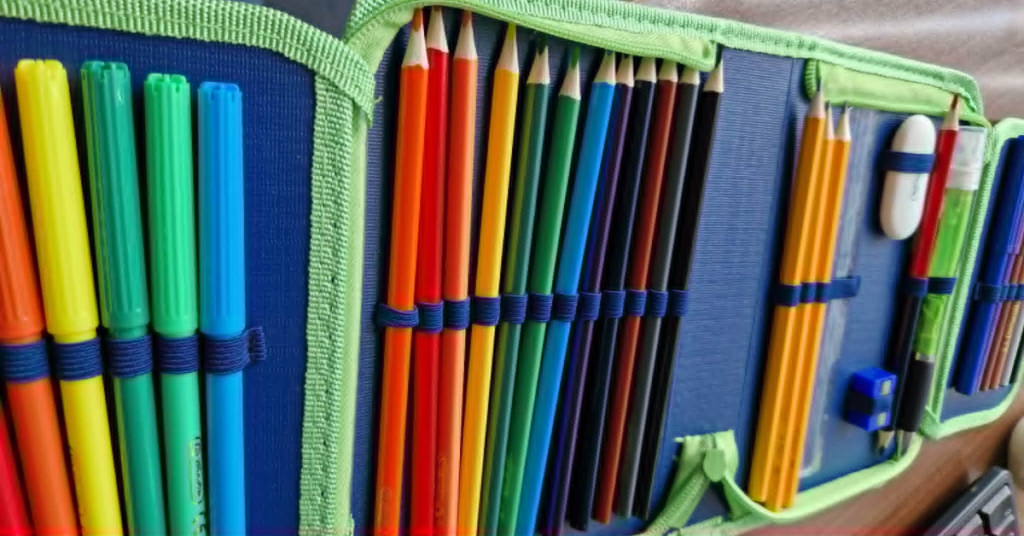
If you have never seen one, search for “pencil case with elastic loops” and you will recognize the concept immediately. They are easy to find online in the US, even though you will rarely see them on an American classroom supply list.
Why not? Mostly because American elementary classrooms work differently. Supplies in the early grades are often communal, boxes need to stack in shared storage, and a loop organizer costs more than a simple box or pouch. The system it belongs to, one child with one complete personal kit, is simply less common in US schools than in European ones.
But the organizer style deserves a place in this guide, because in the right situations it is genuinely the best tool:
Homeschooling families get the full benefit of the organized layout with none of the classroom constraints.
Travel and car activities. The loops keep everything in place upside down, which any parent who has picked crayons out from under a car seat will appreciate.
Art supplies on the go. For a child with a growing colored pencil collection, a loop case protects tips and keeps the set complete. My guide to crayons and colored pencils for kids explains why protecting those tips actually matters for how a child draws.
Children who feel calmer when everything has a clear spot. Some kids genuinely work better when they can see their whole kit and every item has a home. If that describes your child, an organizer case at home, even alongside a school-required box or pouch, can be a small but real help.
So the honest answer: do not send one to school unless the teacher approves it, but do not dismiss the style either. It solves problems the box and the pouch cannot.
What should actually go inside
A pencil case works best when it carries the daily kit and nothing else. Here is what that means by age, assuming the teacher’s list does not spell it out.
Kindergarten to 2nd grade, in a pencil box: two or three sharpened #2 pencils, a box of crayons (the box of crayons usually lives inside or next to the pencil box, depending on classroom rules), one glue stick, blunt-tip scissors, and one big eraser. That is the whole kit. If your child is left-handed, the scissors deserve special attention, and my guide to school supplies for left-handed kids explains exactly why the scissors and one or two other items matter so much.
3rd to 5th grade, in a pouch: three or four #2 pencils, a small sharpener with a shavings container, an eraser, a couple of pens if the teacher allows them, one highlighter, and a 6-inch ruler if it fits. Colored pencils usually stay in their own box at this age.
Middle school, in a binder pouch: two pencils, two pens, one highlighter, an eraser. The minimalist kit. Everything else lives in a locker or at home.
Two principles cover everything else. First, sharpen the pencils before the first day; a case full of unsharpened pencils is a case full of things the child cannot use. Second, when in doubt, send less. A half-empty case closes properly, survives longer, and teaches the child to keep track of a small kit instead of losing pieces of a large one.
And one thing that should not go inside: anything precious. The special eraser collection, the pen from grandma, the fidget toy. School pencil cases live a hard life, and items go missing. Keep the treasures at home.
Common mistakes parents make
After 25 years of hearing what goes wrong with pencil cases, the same handful of mistakes come up every single year. All of them are avoidable.
Buying a different type than the list asked for. The most common mistake and the most expensive one, because it usually means buying twice. If the list says pouch and you send a box, the box may not fit the classroom system at all. Teachers put real thought into those lists. One middle school teacher wrote a widely shared essay on WeAreTeachers explaining that every item on her list has a purpose, down to the specific type of notebook, because a child with the wrong version of an item ends up at a real disadvantage in the actual lesson. The same is true for the pencil case type.
Choosing a licensed character case without thinking it through. I will not tell you never to buy the superhero pencil case. I will tell you what happens next: children’s loyalties to characters change fast, and the case your child begs for in August can feel embarrassing to them by winter break. If you buy licensed, buy it knowing that you may be shopping again in a few months and that the replacement comes out of the same budget. If you want one purchase to last the year, let your child pick a color or pattern instead of a franchise. My article on budget school supplies goes deeper into which items reward spending more and which do not.
Not testing the zipper before buying. Thirty seconds in the store prevents the most common pencil case failure of all. Run the zipper back and forth, feel for snags, check the pull size. If you are buying online, read the reviews and search specifically for the word “zipper.” The complaints, if they exist, will be there.
Switching to a pouch too early. Some parents buy a pouch for a kindergartner because it looks more grown up or packs smaller. Then the child spends part of every lesson digging for a pencil they cannot see. Young children genuinely benefit from the open-flat, everything-visible layout of a box. The pouch will have its turn in a couple of years.
Buying too big. A giant case invites a giant collection, and a giant collection means more digging, more losing, and a case that does not fit the desk. The right size is the smallest one that holds the daily kit comfortably.
Frequently asked questions
Why do some schools ask for a pencil pouch instead of a pencil box?
Usually because of space and storage. Classrooms without individual desk storage need supplies to travel in backpacks, and soft pouches handle that life better than rigid boxes, which can crack. Pouches are also quieter and take less room in shared bins. If the list says pouch, the teacher has a system built around it.
What is the difference between a pencil box and a pencil case?
In American usage, pencil case is the umbrella term, and a pencil box is the specific rigid plastic type with a snap lid. A pencil pouch is the soft zippered type. Supply lists usually use the specific words, which is exactly why it pays to read them closely.
What size pencil box does a kindergartner need?
The standard school size, close to 8 x 5 inches, fits desks and cubbies and holds the full kindergarten kit. Bigger is not better here, because oversized boxes often do not fit classroom storage.
Is a pencil box or a pouch better for first grade?
If the teacher’s list specifies one, that answer wins. If it does not, a box usually serves first graders better, because it opens flat, shows everything at once, and works without zipper skills.
When should a child switch from a pencil box to a pouch?
Most children make the switch around 3rd grade, when classes start moving between rooms and supplies shrink to a smaller daily kit. There is no prize for switching early. The right time is when the school asks for it or when the child manages a zipper and a smaller kit confidently.
Do middle schoolers still use pencil cases?
Yes. By middle school, most students have switched to a soft pouch or a 3-ring binder pouch, because those are easier to carry between classes and take less room in a crowded backpack.
Can a regular pencil pouch replace a 3-ring binder pouch?
Not if the list asks for the binder type. A regular pouch has no ring holes, so it cannot travel inside the binder, and that is the entire point of the request. The reverse works better: a binder pouch functions fine as a standalone pencil case, the empty grommets just go unused.
What does “no hard plastic” mean on a supply list?
It means the teacher specifically wants a soft zippered pouch, not a rigid box. The usual reasons are storage space and broken boxes. Take the note literally, because it exists thanks to past experience.
Can my child use a European-style organizer case with elastic loops at school?
Ask the teacher first. In most US classrooms it is unusual, and in early grades with communal supplies it may not fit the system. At home, for travel, or for homeschooling, the organizer style works beautifully.
How many pencils should go in a pencil case?
Two or three sharpened #2 pencils for the youngest students, three or four for upper elementary. Sharpen them before the first day. The full box of 24 stays at home as the refill supply.
Should I label the pencil case?
Yes, with first and last name, on a smooth surface where the label can survive daily handling. In a classroom with two dozen similar cases, the label is the difference between “lost” and “found.”