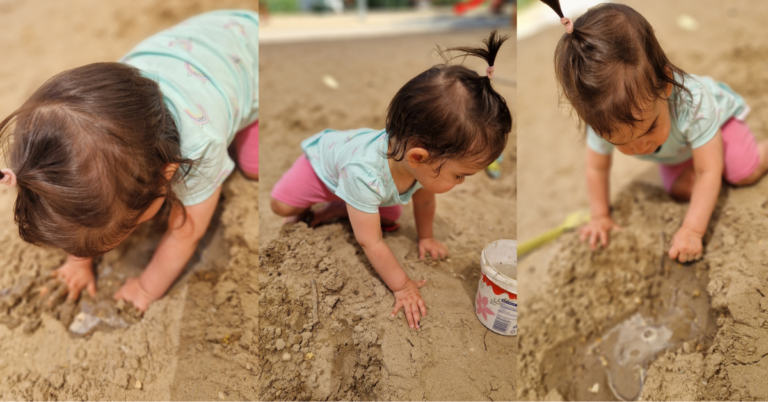
The best toddler learning activities are already in your home
Have you ever spent twenty minutes scrolling through toy shops online, trying to figure out what a fourteen-month-old actually needs, while the child in question sits on the kitchen floor happily banging a wooden spoon against a pot? If so, this post is for you.
When our daughter came home through adoption, I found myself genuinely stumped by this question. As a first time mom to a toddler, I had no reference point. I did not know what she had been used to, what she would respond to, or how to keep a small person engaged without immediately reaching for a screen. We talked about it a lot, my husband and I. We looked at toys. We ordered a few things. And then, slowly, we realised something: the best toddler learning activities were not in any shop. They were already all around us.
If you want to read more about our adoption journey and how our daughter came home, you can find the full story in Our Story.
Why toddler learning activities do not need to be bought
There is a widespread assumption that good play requires good equipment. Fancy toys, purpose-built sensory kits, educational sets with matching cards and colour-coded pieces. And some of those things are genuinely wonderful. But for children under 2, research consistently points to something simpler: caregivers often perceive playing with everyday objects in the home as less beneficial than electronic toys or books, when in fact everyday objects offer rich opportunities for early learning and development.
The reason is straightforward. Open-ended materials promote children’s creative thinking, imagination, and problem-solving skills, and children can use them in many ways without specific directions. They take the lead in the learning experience’s process and approach. A vitamin box filled with coffee beans does exactly this. So does a plastic laundry basket, a cup of water, or a blanket on the floor.
What follows is an honest account of the toddler learning activities that actually happened in our home, with things we already had. None of them were planned. Most of them were discovered by our daughter, not by us.
Toddler learning activities in the kitchen
The onion and potato baskets
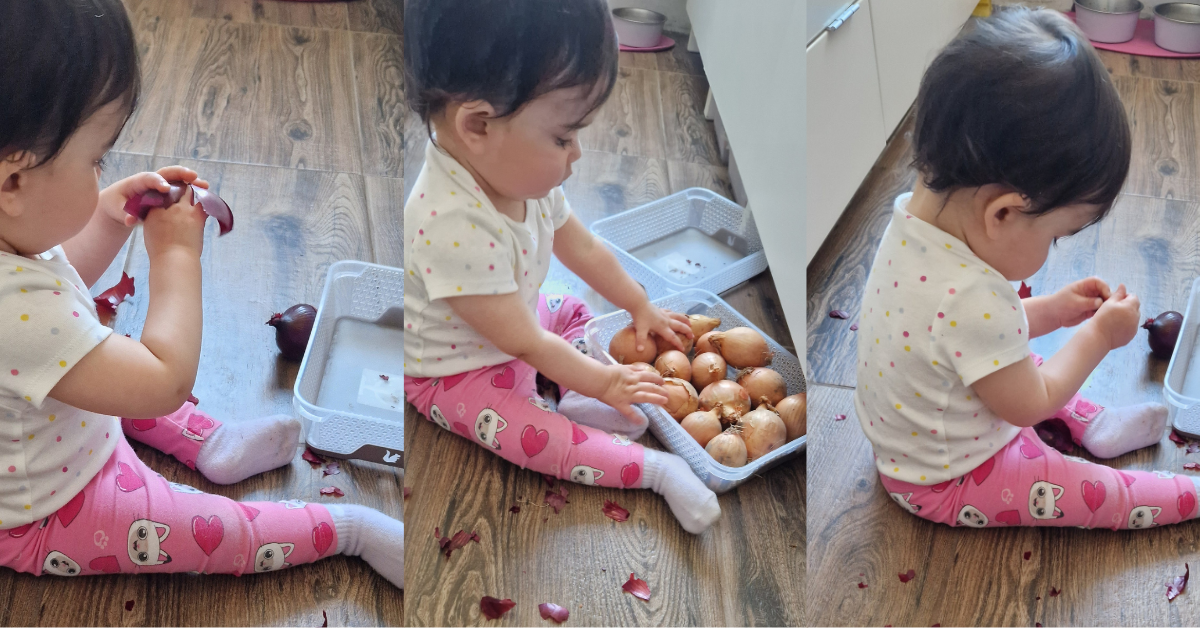
Under our kitchen counter, I keep two small baskets: one for onions, one for potatoes. I never thought of them as anything other than storage. Our daughter had other ideas.
She discovered them early on and became completely absorbed in the unpacking and repacking process. Potatoes out of one basket, into the other. Onions out, sorted, moved. The onion skins were a particular favourite: she would peel at them carefully, examine the papery layers, and carry them around the kitchen with great seriousness. The floor looked like a market stall by the time she was done, but it took about two minutes to tidy up and she had been busy for twenty.
This kind of sorting and transferring is one of the most natural toddler learning activities there is. It develops hand strength, concentration, and the early understanding of categories. And it requires nothing more than what is already in your kitchen.
The vitamin box and the coffee beans
When she was very small, around ten to twelve months, one of her favourite objects was a small opaque vitamin box filled with coffee beans. She could not see inside it, but she could shake it, roll it across the floor, and drop it to hear the rattle. Every interaction produced a slightly different sound depending on what she did, which kept her coming back to it again and again.
This kind of sensory play, where a simple object produces sound, movement, and texture all at once, is exactly what young children need. It does not need a label or a price tag. It just needs to be safe and interesting.
The cup that does not roll straight
For a long time, our daughter used cups the way cups are intended to be used: for drinking. Then she discovered that if you place a tapered cup on its side on a flat surface, it does not roll in a straight line. It curves.
She found this out by accident and then spent a remarkable amount of time repeating the experiment. Cup on its side. Watch it curve. Pick it up. Do it again. She also practised pouring water from a smaller cup into a larger one and back again, which made the bathroom floor very wet but was clearly extremely satisfying.
Pouring and transferring liquids is a classic sensory play idea for good reason. It develops concentration, hand control, and the very early beginnings of understanding volume. A cup of water and a willing adult nearby to mop up is all you need.
Toddler learning activities with everyday objects
The laundry basket
Our plastic laundry basket has had a second life since our daughter came home. She pursued it with considerable determination from the moment she spotted it, and once she had it, she used it for everything.
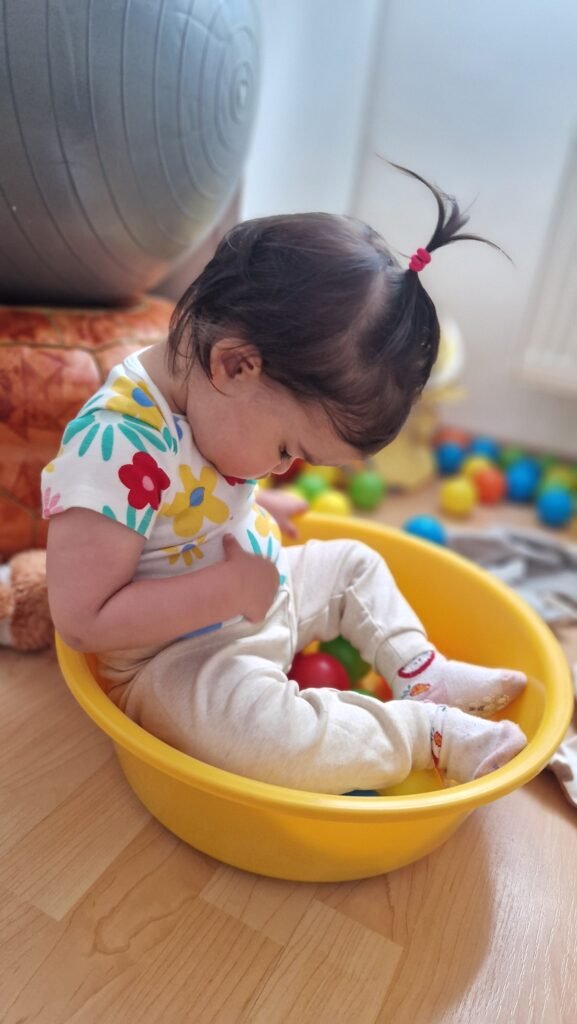
She loaded it with toys and pushed it across the floor like a trolley. She climbed inside it and sat there, looking very pleased with herself, occasionally requesting to be pushed around the room. The climbing in and sitting was its own achievement: she had identified the basket, decided she wanted to be inside it, figured out how to get there, and settled in to enjoy the result.
This turned out to be one of the best early signals she gave us about what kind of play she enjoyed. We bought her a toy pram not long afterwards because it was clear that pushing and transporting things was something she genuinely loved. But the laundry basket came first, and it cost nothing.
The crisp packet
Before she was old enough for the kitchen and the baskets, one of her first favourite objects was half of a crisp packet. Not the crisps. The packet itself.
She loved the crinkling sound it made when she scrunched it in her hands, the way it moved, the way it caught the light. It occupied her completely. This is sensory play in its most basic form: a material that responds to touch in an interesting way, that makes a sound, that is light enough for small hands to manage. She was probably eleven months old. It was perfect for where she was.
Toddler learning activities that involve the whole body
The blanket fort and hide and seek
At some point, our daughter decided that hiding was the best game. She would announce that she was going to hide, disappear under a blanket, and wait to be found. We would search the room out loud, checking under the table, behind the sofa, behind the door, narrating every step. When we finally “found” her, she laughed every time as if it were the first time.
What makes this one of the more underrated toddler learning activities is how much is happening underneath the comedy. She is learning to wait quietly, which takes genuine patience at this age. She is hearing the names of locations: under, behind, beside. She is experiencing the pleasure of being found, which for a child who spent her early months in institutional care carries its own particular warmth.
You need a blanket. That is it.
Bath time foam play
Our daughter learned the names of most of her body parts in the bath. We would put foam on her shoulder, her nose, the top of her head, her chin, and name each one as we went. Forehead. Elbow. Knee. She paid close attention.
Bath time is one of the most natural settings for sensory play ideas that actually work: the water itself, the temperature, the foam, the different textures of sponges and cloths. None of it needs to be purchased. It is already part of the daily routine, which means it happens consistently and at a time when she is already engaged and receptive.
What these toddler learning activities have in common
Looking at this list, the thread that runs through all of it is that none of it was designed. Our daughter found the baskets. She discovered the cup curved. She claimed the laundry basket for her own purposes. We provided the environment and she did the rest.
Children can use open-ended materials in many ways without specific directions; they take the lead in the learning experience’s process and approach. This is what that looks like in practice. It looks like a kitchen floor covered in onion skins. It looks like a wet bathroom and a very satisfied toddler. It looks like nothing, from the outside, and is actually everything.
As a first time mom, I used to worry that I was not doing enough. What I learned is that the question is not what you provide, but whether you leave room for them to discover. The best parenting tip I can offer on this particular subject is a simple one: put interesting things within reach, step back, and watch what happens.
A note on screens
The prompt for this post asked me to address the screen question honestly, so I will.
It is easy to hand a toddler a phone or turn on a programme when you are tired or need five minutes. I am not going to pretend otherwise or tell you never to do it. But toddler learning activities that involve real objects, textures, sounds, and another person’s presence offer something that a screen genuinely cannot: the experience of acting on the world and seeing it respond. The cup curves because she pushed it. The onion skins rustle because she peeled them. The basket moves because she pushed it. That feedback loop, between action and result, is where a great deal of early learning actually lives.
If you are looking for simple outdoor toddler learning activities to complement what you are doing at home, I wrote about what worked for us outside in this post. Many of the same principles apply: everyday materials, child-led exploration, and an adult who is present and paying attention.
FAQ
What are the best toddler learning activities for children under 2?
The best toddler learning activities for children under 2 tend to be open-ended, sensory-rich, and simple. Everyday objects like cups, baskets, and boxes offer more developmental value than many purpose-built toys because children can use them in multiple ways. Sensory play ideas like water pouring, foam play, and crinkling materials are particularly effective at this age.
Do toddler learning activities need to be planned?
No. Some of the most valuable toddler learning activities happen spontaneously when a child is given access to interesting materials and the freedom to explore them. As a parent, your role is less about facilitating a programme and more about creating an environment where discovery is possible.
What is sensory play and why does it matter?
Sensory play refers to any activity that engages a child’s senses: touch, sound, sight, smell, and movement. Sensory play ideas do not need to be elaborate. Bath foam, a rattle made from a vitamin box, or the texture of onion skins all count. At this age, sensory input is how children learn about the world around them.
How do I know if a household object is safe for toddler play?
The basic checks are: no sharp edges, no small parts that could be swallowed, no toxic materials, and nothing that could break apart under pressure. When in doubt, stay close and watch. Most kitchen objects that pass these checks make excellent toddler learning activities.
Can toddler learning activities support bonding after adoption?
Yes. Activities that happen side by side, where you are present and responsive rather than directing, are particularly good for building connection. The hide and seek game, the sorting, the bath time foam play: these are all moments of shared attention and warmth. They do not need to be labelled as bonding exercises. They just need to happen, consistently and without pressure.