15+2 Summer toddler learning activities under 2 that actually work (and build bonding too)
Are you staring at a long summer afternoon wondering how to keep your toddler busy, engaged, and away from screens, without losing your mind in the process? You are not alone. Finding toddler learning activities that actually hold a under-2’s attention, cost next to nothing, and happen to build your bond at the same time is one of the quiet challenges of early motherhood that nobody really prepares you for.
This past summer, I found myself figuring it all out in real time. Our daughter came home through adoption just before summer arrived, and suddenly I had a curious, energetic toddler who had spent most of her life indoors, with a whole wide world still to show her. We quickly learned that not all outdoor time felt the same for her: the playground was stimulating and exciting, but the forest was where she truly settled. So we made space for both, deliberately. These are the toddler learning activities that worked for us. Shared not as expert advice, but as one parent’s honest account of a summer spent paying close attention.
Why outdoor toddler learning activities matter more than you think
Before we get into the list, it is worth saying this: outdoor play is not just fun. It is genuinely developmental.
Research shows that outdoor toddler activities support both fine and gross motor skill development, sensory processing, concentration, and emotional regulation. All at once, and all without any structured lesson plan. For toddlers under 2, the natural world offers exactly the kind of open-ended, multi-sensory input their developing brains are hungry for.
And for adoptive families, or any family navigating a period of bonding and adjustment, there is something else worth noting: being outside together, moving at your child’s pace, following their curiosity: this is some of the most powerful bonding work there is. It does not look dramatic. It looks like watching ants. But it counts.
15 summer toddler learning activities under 2 (that cost almost nothing)
1. Sand play and mud making
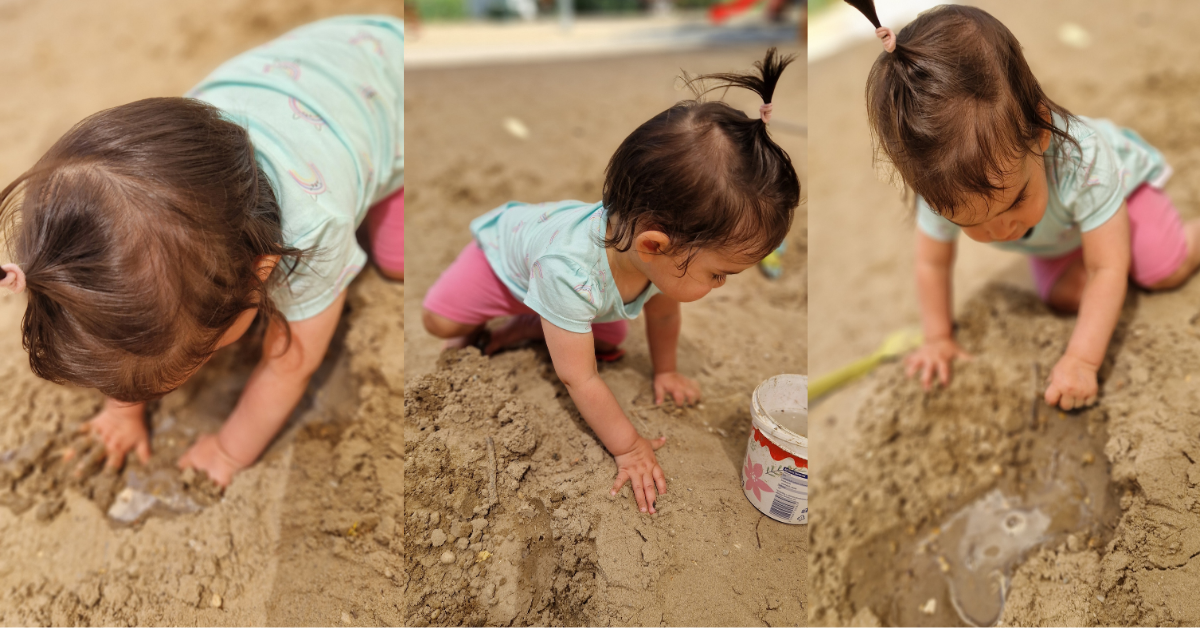
Sand is one of the oldest and best toddler learning activities there is, and for good reason. Our daughter was not interested in building sandcastles at first — she just wanted to dig, squeeze, and feel the texture run through her fingers. That is exactly right for her age.
On the hottest days, we brought a small bucket of water to the playground and let her make mud. She kneaded it with her hands and her feet, completely absorbed. Sand and mud play develops fine motor strength, hand-eye coordination, and sensory processing. And it costs nothing if you have access to a playground sandpit.
What it develops: fine motor skills, sensory processing, concentration
2. Sliding
The first time our daughter went down a slide, she looked genuinely surprised. The second time, she laughed out loud. In time, she was sliding on her stomach, headfirst, backwards. Absolutely fearless.
The slide is one of those toddler learning activities that looks simple and delivers a great deal. It builds body awareness, spatial understanding, and confidence. And the joy on their faces when they finally master something independently is a bonding moment all on its own.
What it develops: gross motor skills, body awareness, confidence
3. Swinging with a song
Swinging has been our daughter’s constant favourite since she was tiny. There is something about the rhythm of it that is deeply soothing for young children. We always sang together while she swung. A Hungarian nursery rhyme that became our song, repeated a hundred times until she knew every word.
If you are looking for toddler summer activities that are both calming and connecting, the swing is it. The repetitive movement supports sensory integration, and singing together builds language and attachment at the same time.
What it develops: sensory integration, language development, bonding
4. Trampoline play
Our daughter watched the other children on the playground trampoline for a long time before she was ready to try it. When she finally stepped on, the surface confused her. She had no reference for how it moved. I held her hands and gently bounced her until she understood what her body was supposed to do.
What struck me was that she only really enjoyed it when we were there beside her, holding on. The trampoline became less about the jumping and more about the trust. That is one of the things toddler learning activities teach you: sometimes the activity is the vehicle, and the connection is the point.
What it develops: gross motor skills, balance, trust
5. Hanging and climbing
Do not overlook the older playground equipment just because it seems too advanced. With full supervision and your hands right there, toddlers can hang from bars and low climbing frames in ways that are genuinely excellent for upper body strength and grip development.
Our daughter loved to hang. Just grip, suspend, and feel her own weight. It looked simple. It was actually hard work, and she knew it. These kinds of toddler learning activities build physical confidence in a way that softer play cannot replicate.
What it develops: upper body strength, grip strength, physical confidence
6. Balance bikes and ride-ons
Learning to propel a ride-on toy forward takes longer than you would expect. Our daughter spent weeks going backwards before she figured out the forward motion. She watched the other children carefully and then, one day, something clicked.
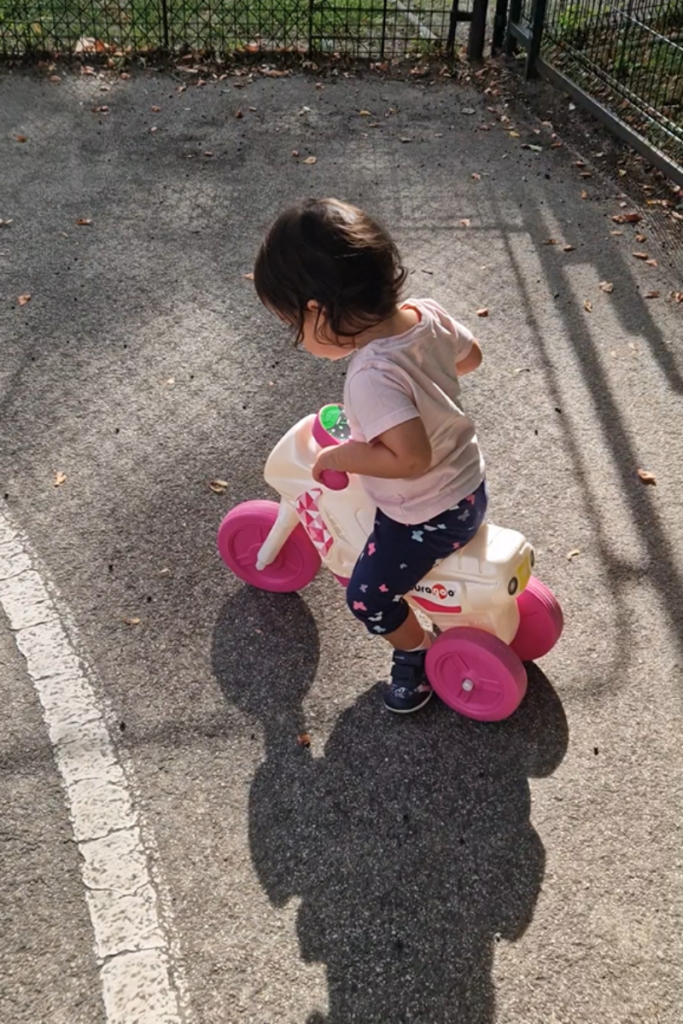
Toddler outdoor activities involving wheels are excellent for leg strength, coordination, and problem-solving. And the moment they get it — the look of pure satisfaction: it is one you will not forget.
What it develops: leg strength, coordination, problem-solving, persistence
7. Flying a foam plane
Her grandparents brought a small foam plane on one of our outings, the kind you throw and watch glide in a wide arc before landing. We were out in a meadow with Stella, and the moment the plane left someone’s hand and sailed through the air, our daughter screamed with delight. Stella, it turned out, felt exactly the same way: she sprinted after it and picked it up before anyone else could get there.
We all laughed. Neither of them could quite believe what had just happened.
Our daughter tried to throw it herself, but at that age the plane mostly met the ground immediately. So she appointed herself director instead: pointing at whichever adult should throw next, indicating very clearly that it needed to go high and far. Stella chased every single one. By the end of the afternoon the dog was exhausted and our daughter was thoroughly satisfied with the whole arrangement.
What it develops: visual tracking, anticipation, shared joy
8. Bubble play
Bubbles are a classic for good reason. Our daughter chases them, tries to catch them, watches them pop, and laughs every single time, even when she has seen it a hundred times before.
But there is more to bubble play than it looks. We played a game where she had to stomp on bubbles we held low to the ground — this develops balance and single-leg weight-bearing. We also practiced blowing bubbles ourselves, which is excellent for oral motor development and breath control.
What it develops: gross motor skills, balance, visual tracking, oral motor development, breath control
9. Pavement chalk
We came across chalk by chance one afternoon. Another family had brought a box to the playground and left it out for everyone to share, and our daughter spotted the colourful drawings on the pavement long before we reached the gate. Something was different about the ground today, and she knew it immediately.
She went straight for the chalk. Her first instinct was to taste it, which I redirected as gently as I could while explaining that the colourful little stick was not, in fact, delicious. Once that was settled, she tried drawing: mostly lines and marks, nothing recognisable, but the focus on her face was total. She spent at least as much time sorting the colours in and out of the box as she did drawing, which is also exactly right for her age.
The second time she encountered chalk, she went straight to drawing, as if she had been thinking about it since the last time. The sorting still mattered too. Both things counted.
What it develops: fine motor skills, grip strength, cause and effect
10. Forest walks in the shade
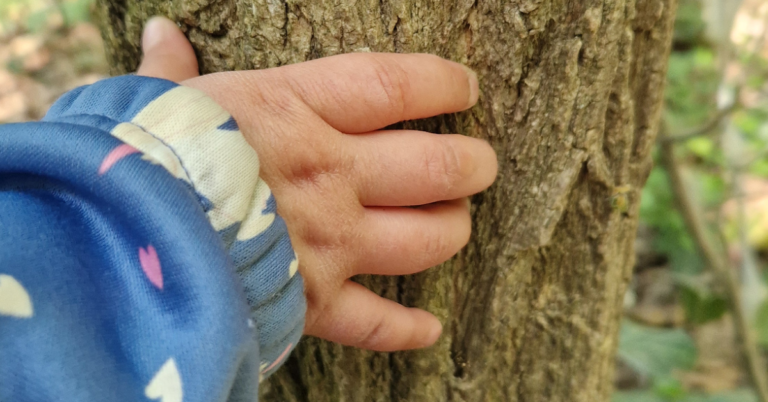
On the hottest summer days, the forest is the best toddler outdoor activity you have. The temperature drops under the trees, the ground is uneven and interesting, and there is always something to look at, listen to, or touch.
We talked about everything we passed: the bark, the roots, the shapes of leaves, the sounds of birds. I wrote about what forest time looked like for our daughter and what it taught us in this post. It changed how I understood what she needed.
Nature provides a calming effect, reducing stress and improving attention spans. For toddlers who are still learning to regulate their nervous systems, that matters more than any structured activity could.
What it develops: sensory processing, language, emotional regulation, gross motor skills
11. Ant watching
This is not a programme. It is just stopping and looking down.
We discovered ant watching by accident, next to a sandpit on one of our regular playgrounds. It was our daughter who noticed them first, not me. She spotted a single ant moving across the ground and started tracking it with her finger. That is how we found the whole trail: dozens of ants moving in and out, carrying things, disappearing, reappearing, busy with something completely their own.
I would never have thought to point this out myself. She led, and I followed. She watched for so long that in the end I had to physically carry her away from the sandpit, because standing there watching ants was apparently a perfectly acceptable way to spend an afternoon.
Toddler learning activities do not have to be engineered. Sometimes the best ones are already there on the pavement, waiting for a small person to notice them.
What it develops: concentration, observation, patience
12. Looking at flowers and bushes on walks
Adults tend to walk past flowering bushes and garden fences without noticing them. They are just part of the background. It took my own mother pointing this out to me before I started doing it differently: the small gardens near our usual walking routes were worth stopping at, because for a toddler, every flower is new.
We started building short detours into our walks just to look at whatever was in bloom. We named every colour we saw, pointed at the bees landing on petals, and crouched down to look more closely at shapes and textures. What would have been a two-minute stretch of pavement took fifteen minutes to walk. Our daughter examined everything with complete attention.
This is one of the simplest and most underestimated toddler summer activities. You do not need to go anywhere special. You just need to slow down enough to see what is already there.
What it develops: language development, colour recognition, shared attention
13. Ball play
Rolling, throwing, kicking, chasing: ball play adapts to every stage and every mood. When our daughter kicks a ball and it actually goes somewhere, the pride on her face is enormous.
Ball play is one of the best toddler learning activities for building leg strength, hand-eye coordination, and the early foundations of turn-taking. If you direct it gently, you can work on specific movements. If you let her lead, you will learn a great deal about what she is working on.
One thing we noticed on the playground: older children are often happy to kick or roll a ball with a toddler, and toddlers watch them very carefully. They pick up movements by watching, not by being taught. Sometimes the best thing you can do is step back and let the bigger kids do the work.
What it develops: gross motor skills, coordination, turn-taking, social development
14. Pushing a toy pram or trolley
Our daughter loved putting something, anything really, into her toy pram and pushing it from one point to another. Sometimes the pram was empty and she enjoyed the noise it made. That was also fine.
Pushing a wheeled toy develops core stability, coordination, and a sense of purpose and agency. For toddlers under 2, having something to be in charge of is genuinely satisfying. This is one of those toddler learning activities that looks like pretend play and is actually a lot more.
What it develops: coordination, balance, sense of agency
15. Stone and pebble collecting
Wherever we went, our daughter collected stones. She sorted them, held them, dropped them down the slide one by one and watched them go. She filled buckets, emptied them, filled them again.
Stone collecting is a wonderful and completely free toddler outdoor activity. It develops grip strength, sorting skills, cause-and-effect understanding, and the deep satisfaction of gathering things. It also keeps a toddler busy for a remarkably long time.
What it develops: fine motor skills, sorting, cause and effect, concentration
+2 bonus activities (worth the planning)
These two summer toddler activities cost a little more or require a specific location. If you have access to them, they are absolutely worth it.
Bonus 1: Beach or outdoor pool
Water play is one of the most developmentally rich toddler summer activities there is. The sensory input alone is extraordinary: temperature, resistance, movement, all at once.
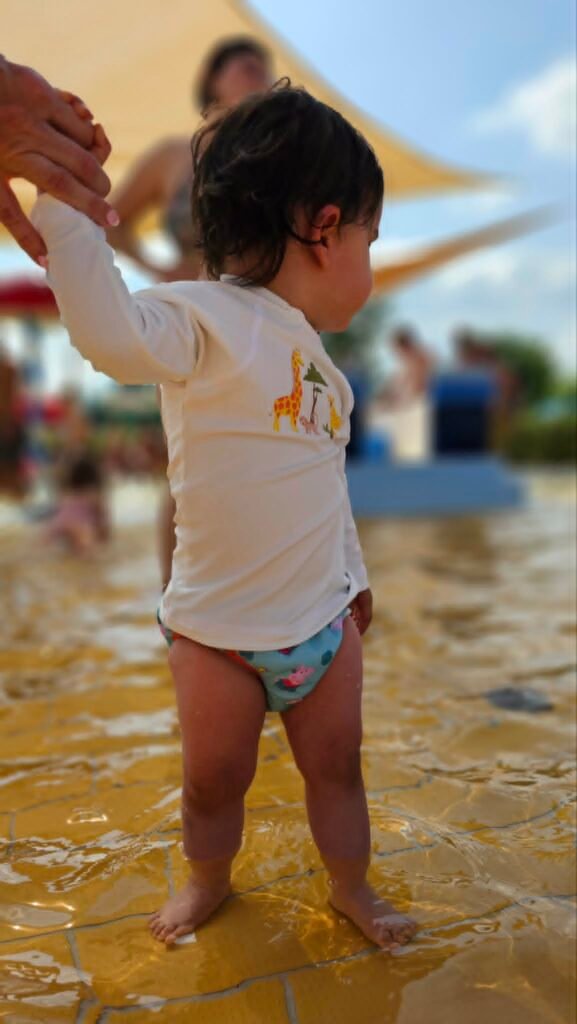
One honest note from our first beach trip: it takes one second. Our daughter was in a paddling pool where the water came to my knees. My husband looked away for a moment to glance at me. When he looked back, she was already face-down in the water, perfectly calm, staring at the bottom. No harm done, and we laugh about it now. But please: one second is all it takes. Do not look away.
What it develops: sensory processing, water confidence, fine and gross motor skills
Bonus 2: Miniature train ride
If there is a miniature train near you, the open-carriage kind that runs through parks or countryside, this is a genuinely magical toddler summer activity. The movement, the sound, the view from a moving vehicle: it is completely different from everyday life, and children feel that.
Our daughter did not fully understand what a train was. But she understood that something extraordinary was happening, and she watched everything with enormous attention.
What it develops: sensory processing, attention, wonder
What these toddler learning activities have in common
Looking back at this list, the thread that runs through all of them is simple: your presence.
None of these toddler outdoor activities require equipment beyond what most families already have access to. What they all require is you, crouching down to their level, following their lead, and staying long enough for the moment to become something.
As a first time mom, I used to think I needed to be doing something: teaching, facilitating, improving. What I learned this summer is that showing up and paying attention is enough. More than enough.
If you want to read more about our family’s story — how our daughter came home, what those first weeks looked like, and how we slowly found our rhythm together — you can find it in Our Story.
FAQ
What are the best toddler learning activities for under 2?
The best toddler learning activities for children under 2 are open-ended, sensory-rich, and low-pressure: sand play, water play, bubble play, nature walks, stone collecting, and outdoor swinging. These activities support motor development, language, and bonding without any structured teaching.
Are outdoor toddler activities better than indoor play?
Both have value, and most experts recommend a mix. Outdoor toddler activities offer sensory input that is difficult to replicate indoors: varied terrain, natural light, temperature, and sound. They also support gross motor development in ways that indoor spaces cannot. On hot summer days, forest walks and shaded playground time are ideal.
How long should toddler outdoor activities last?
Follow your child’s lead. Toddlers under 2 often engage deeply for short periods — ten minutes of sand play or ant watching can be highly productive. Do not rush to the next activity. The depth of engagement matters more than the length of time.
Can toddler learning activities support bonding after adoption?
Yes. Outdoor activities that follow a child’s lead, where you slow down, observe, and respond to what interests them, are a gentle and powerful way to build trust and connection. You do not need to engineer the bonding. Being present and consistent is what does it.
What toddler summer activities work without spending money?
Almost all of the activities on this list cost nothing beyond what you already have: a playground, a pavement, a forest path, a handful of pebbles. A foam plane from grandparents costs almost nothing. Chalk is inexpensive. Bubbles are inexpensive. The rest is time and attention.