The adoption day when she came home: what nobody tells you about the first 24 hours
Did you ever wonder what an adoption day actually feels like, not the version in the Instagram photos, but the real, unfiltered, exhausted version that nobody posts about?
I’m going to tell you. Because the adoption day our daughter came home was one of the most overwhelming days of my life, and I think you deserve to know that before yours arrives.
The adoption day began with a small bag and a big silence
We drove to the baby home that morning knowing everything was about to change. We walked in, said goodbye to the caregivers who had looked after her for fourteen months, women I will never be able to thank properly, and we walked out with our daughter and one small carrier bag that held everything she owned in the world.
I held that bag on my lap the whole drive home and barely said a word.
There are moments in life that are so full they have no room for language. This was one of them.
If you are a first time mom waiting for your adoption day, know this: the quiet in that car is not emptiness. It is something so large it has not found its shape yet.
Stella was not impressed
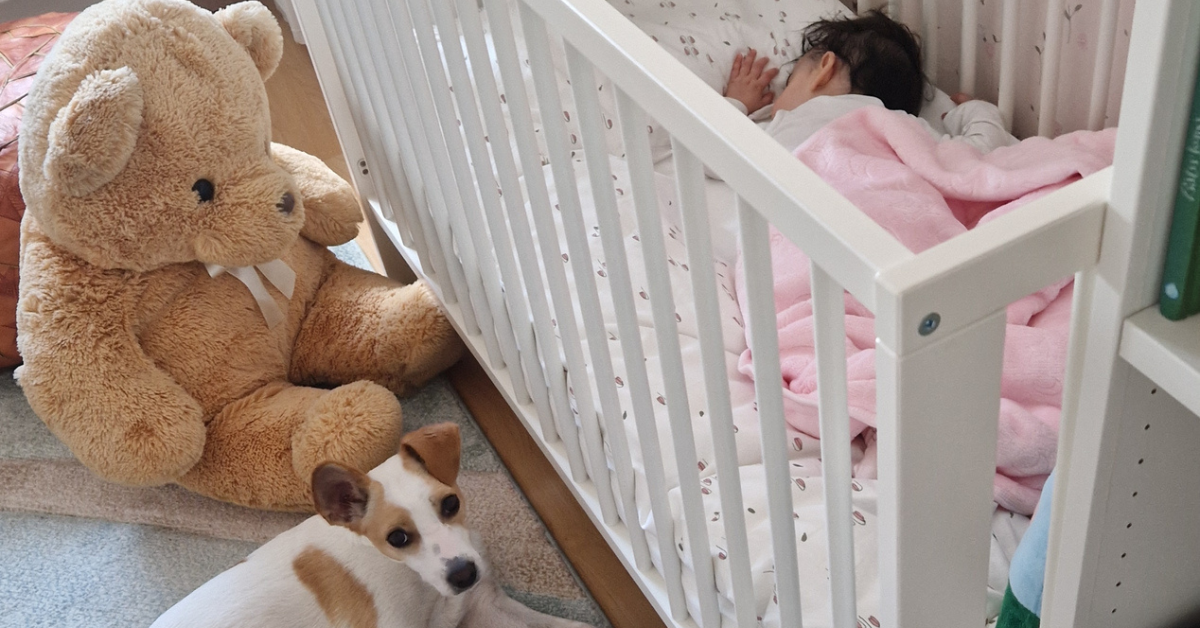
Before we went upstairs on that adoption day, we took a small detour. We brought our little blossom to the park in front of our building, put her in the stroller, and brought Stella down to meet them outside on neutral ground, as we had been advised.
Stella trotted happily around the stroller. Tail up, curious, unbothered. We thought: this is going well.
It was not going well. She simply hadn’t understood yet.
The moment we got upstairs and lifted our little blossom out of the stroller, Stella’s whole energy shifted. Our little girl wasn’t walking yet, she moved on all fours, crawling across the floor, and Stella, who had never encountered a small human moving at dog height, was completely thrown. She became guarded. Territorial. Confused. She started defending her space from what looked to her, apparently, like a very strange and uninvited small animal.
It was distressing. We had done everything right: the pre-introduction walk, the joint homecoming, all of it. And our furry firstborn was still not rolling out the welcome mat.
I want to say it got better that day. It didn’t, really. It took time. But it did get better.
What the experts say about the first day home, and what they don’t
Here is what the research tells us: the first two years after birth are essential for forming healthy early attachment relationships. Children develop a kind of internal template for what a caregiver relationship looks and feels like, and when that template is disrupted, as it is for every child who moves from one home to another, the transition takes time.
What this means in practice is that your adoption day is not the finish line. It is the starting gun.
Experts in adoptive parenting suggest treating an older baby or toddler like a newborn in those early days: holding her, making eye contact, being physically present and responsive, allowing the bond to develop through the ordinary rhythms of feeding, bathing, and play. The bonding doesn’t happen in a single magical moment. It happens in the accumulation of ten thousand small moments across weeks and months.
That is reassuring and humbling in equal measure.
Lunch was fine. The nap was not.
Our little blossom ate her lunch with enthusiasm. That, at least, went according to plan.
What followed did not.
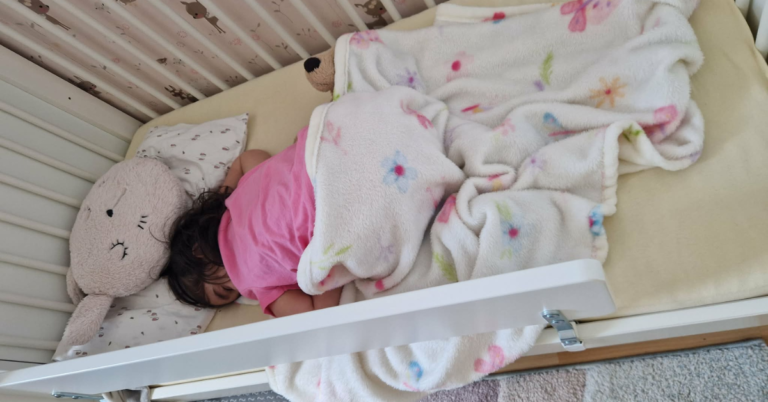
She refused to sleep.
This was surprising. During the intensive getting-to-know-you week, she had napped at our flat several times without protest. But this was different. This was permanent. And somehow, even at fourteen months old, she seemed to know it.
She cried. And cried. I sang to her. I read to her. My husband tried. I tried again. She just kept crying, not distressed crying exactly, but a deep, insistent, full-body protest that said: something has changed and I know it and I am not okay with it yet.
I have since read that many adoptive parents observe exactly this kind of reaction in the first days home. Some experts believe that children, even very young ones, register the permanence of a move before they have words for it. The crying is not manipulation. It is communication. It is a child processing something enormous in the only language available to her.
At the time, of course, we didn’t know any of that. We just knew she was crying and we couldn’t fix it.
The mistake we made, and what it taught us
We decided not to push the nap on that first adoption day. We thought: she’ll tire herself out by evening. She’ll sleep better tonight.
This, as I now know, is one of the classic first time mom errors. When a toddler skips a nap, she doesn’t become pleasantly tired. She becomes overtired. And an overtired toddler at bedtime is a very specific kind of chaos that no parenting book quite prepares you for.
By evening, our little blossom was exhausted beyond the reach of soothing. She screamed. We tried everything. The later it got, the more frantic she became, and the more frantic we became, and the more our anxiety fed hers in a loop that seemed impossible to break.
I called my mother. She panicked, convinced that we were about to change our minds, that the difficulty of this first day was going to undo everything. I had to reassure her that we were not reconsidering anything. We were just two people who had never been parents before, trying to figure out how to help a child who had never had parents before.
That is the thing about parenting nobody tells you: it is learned. All of it. Even in the most loving families, even with the most prepared parents, you are making it up as you go. You are learning your child while she is learning you.
What finally worked
We had to stop trying to fix her and start fixing ourselves first.
My husband and I took a breath. We made ourselves slow down. We lowered our voices. We stopped trying so hard and started just being present: calm, steady, there.
And something shifted.
Experts in adoptive parenting point out that children look to us for how to react and respond in both difficult and joyful moments, and that our role on that first adoption day is to be the calm, safe, regulated presence that allows them to co-regulate. We cannot give our children calm if we are not calm ourselves. That night, we finally understood that in our bones.
She settled. Slowly, then all at once. She fell asleep.
The night that surprised us both
I had braced myself for a terrible night. After the afternoon we had just survived, the screaming, the overtiredness, the loop of anxiety feeding anxiety, I fully expected the night to be more of the same.
It wasn’t.
Most specialists in adoptive parenting will tell you that the first real meltdown comes weeks later, once a child has settled enough to feel safe, and safe enough to finally fall apart. The emotional explosion, they say, is a sign that trust has been established. You usually have to earn it.
Our little blossom did not get that memo.
She delivered a full, unrestrained, nothing-held-back meltdown on day one. No warm-up period. No easing in. She made it absolutely clear, at considerable volume, that she had opinions and that she was not afraid to share them.
Looking back now, it was the first sign of something we would come to know very well: our little blossom is a remarkably determined little person. She arrived with a strong personality and a willpower to match.
After she finally fell asleep, she woke only once through the night. She asked for water in her quiet, still-wordless way. We gave it to her. She went back to sleep.
I lay awake for a long time after that, listening to her breathe, equal parts exhausted and amazed.
What I want you to know before your adoption day
If you are reading this because your adoption day is coming, or because you are still waiting, still hoping, still somewhere in the paperwork, here is what I wish someone had told me:
The first adoptoin day will probably not look like the photos. It will be loud in some moments and heartbreakingly quiet in others. You will make mistakes before dinner. You will feel things you don’t have names for. You will be more tired than you expected and more in love than you knew was possible, sometimes simultaneously.
None of that means anything is wrong.
It means you became parents today. And parenting is not a destination you arrive at. It is something you learn, slowly, in the company of the small person who is also learning you.
The adoption day is just the first day of that education. And it is a very good place to start.
Want to read the whole story?
This post is part of our ongoing series about adoptive parenting and family life. If you want to follow our journey from the very beginning, here is where to start:
- Part 1: Before the YES — the story behind our adoption journey
- Part 2: We Said YES — our honest adoption application story
- Part 3: Hungarian adoption process vs. the U.S. — two fundamentally different systems
- Part 4: The call that changed everything
- Part 5: The weeks before she came home
- Part 6: The day she came home
FAQ — The first day home after adoption
What should I expect on adoption day?
Expect the unexpected. The first adoption day home is emotional, exhausting, and rarely goes exactly to plan. Your child may be quieter than expected, or louder. Routines may not hold. That is completely normal, for them and for you.
Why did my adopted child refuse to sleep on the first day home?
Many adoptive parents report this. Even very young children seem to register that something permanent has shifted. The refusal to sleep is often a form of processing, not defiance. Keeping routines as consistent as possible and avoiding overtiredness will help.
Is it normal to feel overwhelmed on the first day home with an adopted child?
Completely normal. The first day of adoptive parenting combines sleep deprivation, emotional intensity, and a complete lack of experience with a specific child. Give yourself the same patience you are giving her.
What do experts say about bonding on adoption day?
Experts consistently emphasise that bonding is a process, not an event. It develops through repeated, responsive caregiving over weeks and months, not through a single perfect moment on day one. Be patient with yourself and with her.
When will my adopted child feel truly at home?
Every child is different. Some settle within weeks, others take months. Many specialists note that a child showing her full emotional range, including difficult emotions and real meltdowns, is actually a positive sign that she feels safe enough to be herself.